
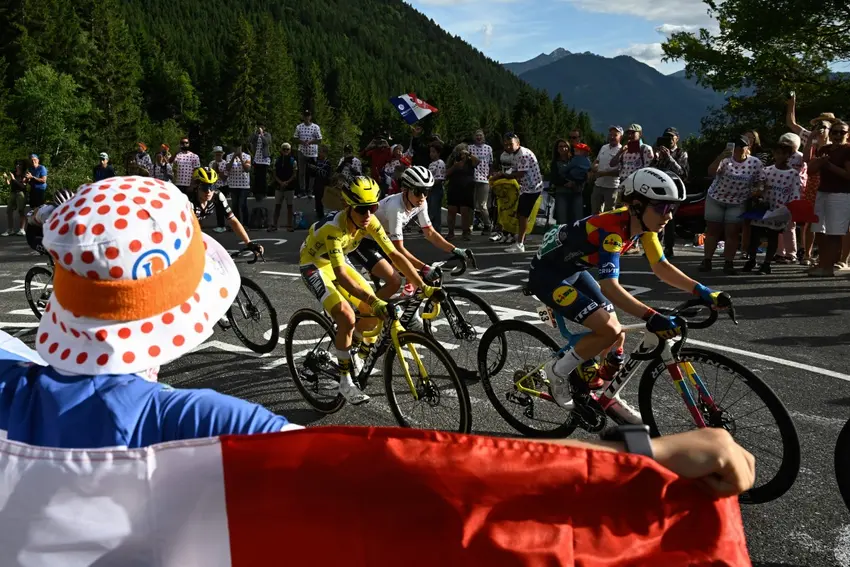
It took 119 years for the organisers of the Tour de France to stage a dedicated women’s race, despite years of lobbying from stars of the pedals, and several unofficial events covering exactly the same route as the men’s race.
This year, some 154 riders, representing 22 teams, will race a total of 1,175km over nine days, from Lausanne in Switzerland to Nice, on the south-east coast of France.
The race – the longest in the five-year history of the official Women’s Tour de France – will include passes in the Jura, Massif central and Alps mountain ranges, including a stage on the formidable Mont Ventoux, and cross 12 departments in three regions.
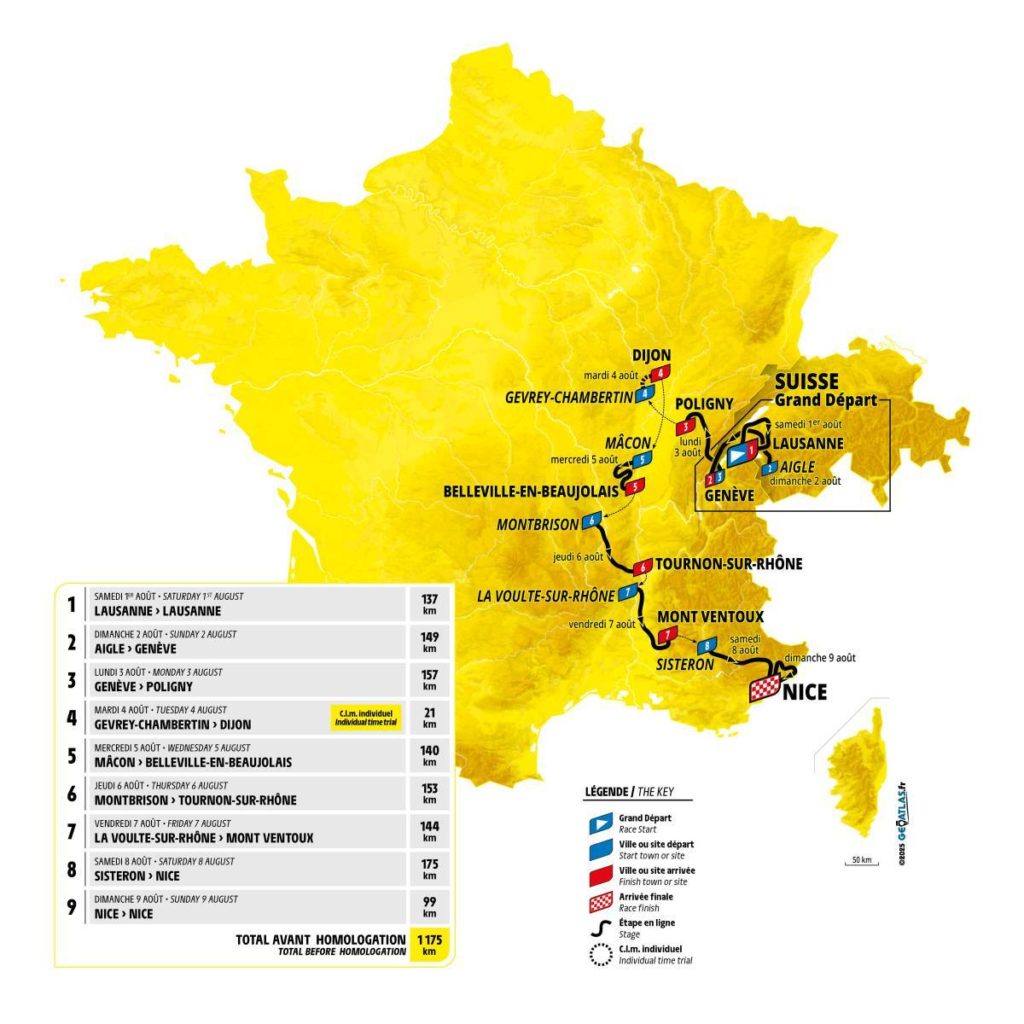 The 2026 Tour de France Femmes route. Graphic: ASO / Tour de France
Unlike last year's west-to-east women's Tour, this one remains within the eastern half of France, but takes in some formidable climbs that will make for an excellent spectator experience.
As with the men's Tour, you can go and watch any part of the race - the start and finish points in towns are usually the busiest although the toughest mountain passes can also get quite crowded.
Also as with the men's Tour the caravane publicitaire arrives ahead of the riders - this is a collection of colourful floats and lorries, provided by race sponsors, who chuck free gifts into the crowd (T-shirts, hats, snacks and the like) and generally whip up the excitement before the peloton arrives.
For this reason, it's a good idea to arrive early and secure yourself a good spot.
Stages
If the Tour is coming through a town near you, it's definitely worth going to watch, even if you're not a big cycling fan - especially as France has a couple of potential champions this year, so expect the crowd to be going crazy.
If, however, you are more serious about the sport, you might like to pick a stage.
The seventh stage – the one featuring a finish at the top of Mont Ventoux, 1,910m above sea level – will see riders take on a vertical gain of 3,565m in a single 153.4km stage. Across the nine stages of this year’s race, the riders will climb a total 18,795m.
The race starts with a challenging 138km ride that’s officially considered ‘flat’ despite a 2.5km climb up a 4.6 percent incline towards the back-end of the stage, after the riders have looped towards Lake Neuchâtel from Lausanne and taken on a one-two punch of climbs.
Stage four is an individual time trial from Gevrey-Chambertin to Dijon, featuring a cheeky 1.8km climb at Marsannay-la-Côte before a second 1km heading to Corcelles-les-Monts.
The final stage, meanwhile, which starts and finishes in Nice, may only be 99.2km – but it features the Col d’Eze climb not once but four times. Champions will cross the finish line in Nice on Sunday, August 9th.
And on TV
Cycling fans unable to get to eastern France for the race can still watch it on TV.
The terrestrial channel France 2 will be providing daily coverage of the action.
Comments